The three pillars of advantage in an AI-democratised world
When everyone has a superpower, no one does. The democratisation paradox killing your competitive edge
2/6/20267 min read
My post content
When Everyone Has a Superpower, No One Does: The Democratisation Paradox Killing Your Competitive Edge
February 2, 2026
Remember when having a professional website was a competitive advantage? When creating stunning graphics required a degree and expensive software? When building software meant hiring a full development team?
Those days are gone.
We're living through an exhilarating moment. Millions of people are discovering that barriers that seemed insurmountable just years ago have crumbled. AI tools have democratised content creation, software development, marketing automation, graphic design, and countless other capabilities that once required specialised expertise and significant capital investment.
The giddiness is palpable, and justified.
But there's a sobering reality lurking beneath the celebration: when tools become universally accessible, they cease to be differentiators. And when everyone can do what you do, your leverage evaporates.
This isn't the first time we've witnessed democratisation eliminate competitive moats. History offers instructive precedents:
Design's Democratisation Dilemma Graphic designers spent years mastering complex software and developing aesthetic sensibilities. Then platforms like Canva emerged, offering templates and intuitive interfaces that enabled anyone to create professional-looking designs in minutes. Canva grew to 220 million users and facilitated the creation of over 30 billion designs, fundamentally reshaping the competitive landscape. Professional designers now face the uncomfortable reality that their hard-won technical skills have lost their "patina of rarity," forcing them to compete on creativity, strategic thinking, and unique perspectives rather than execution capability.
Content Marketing's Capability Collapse Content marketing agencies built businesses on their ability to produce high-quality written and visual content at scale. Then generative AI arrived. Generative AI democratises content marketing capabilities, disrupting traditional agency-client dynamics and reducing demand for basic production services. Agencies that once thrived on execution are scrambling to redefine their value propositions, shifting toward creative consulting, strategy, and hyper-personalisation, which are the capabilities AI hasn't yet commoditised.
The AI Acceleration The current AI revolution compresses these dynamics to an unprecedented degree. What took organisations three years to build now takes three months to replicate, and the gap shrinks every quarter. Solo founders with no technical background can now prototype differentiated features, automate workflows that once required teams of 15, and generate professional content that matches entire marketing departments, all without the overhead, organisational drag, or approval processes that slow larger competitors.
The pattern is clear and brutal: technological democratisation systematically destroys advantages built on execution capability, forcing organisations to compete on dimensions that remain genuinely scarce.
The Three Pillars of Sustainable Advantage in an AI-Democratised World
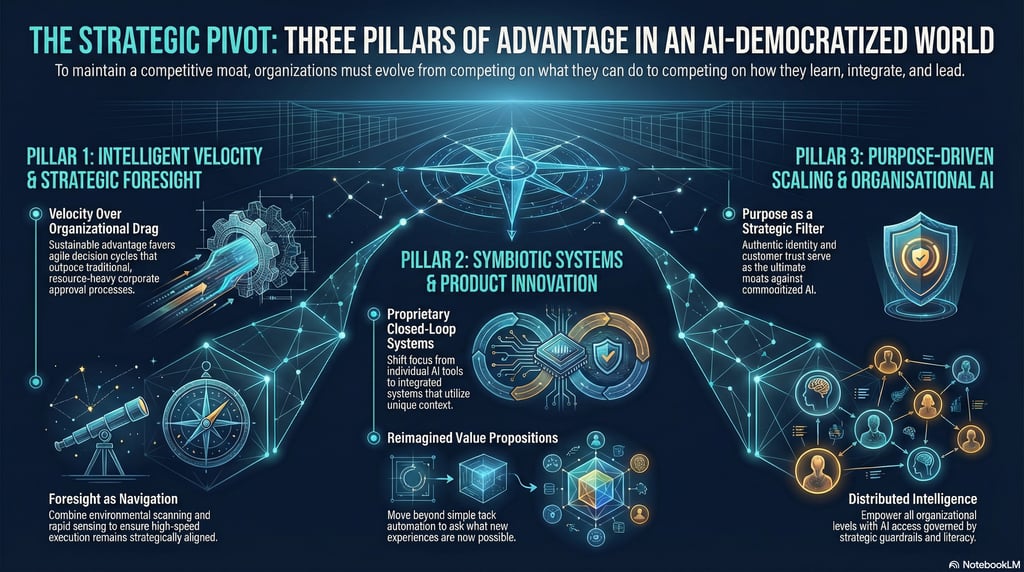
In this landscape of relentless commoditisation, sustainable competitive advantage requires a fundamental strategic reorientation. Organisations must evolve from competing on what they can do (execution) to competing on how quickly they learn, how effectively they integrate capabilities, and how clearly they understand their purpose. This transformation rests on three essential pillars:
Pillar 1: Intelligent Velocity & Strategic Foresight
When AI compresses development timelines and lowers execution barriers, speed becomes the new moat, but not speed for its own sake. The competitive edge belongs to organisations that combine velocity with strategic foresight.
The Execution Velocity Imperative Solo operators with zero organisational drag are generating more revenue than 50-person companies backed by millions in venture capital, shipping on Monday, getting feedback on Tuesday, and iterating on Wednesday. They're not smarter, they're faster and more adaptable. Large organisations with superior resources are losing to agile competitors because their decision cycles, approval processes, and organisational complexity slow them.
Intelligent velocity means ruthlessly eliminating organisational friction. It means empowering teams to make decisions and ship solutions that solve real problems now, not solutions that might be perfect someday. It means treating your roadmap as a hypothesis to be tested, continuously reframed and improved.
Strategic Foresight as Navigation But velocity without direction is chaos. Organisations need strategic foresight, the ability to anticipate market shifts, evolving customer needs, and emerging opportunities before they become obvious to everyone else. This requires:
Continuous environmental scanning: Not just monitoring competitors, but understanding fundamental shifts in customer behaviour, regulatory landscapes, and technological capabilities
Scenario planning: Developing multiple strategic options based on different potential futures
Rapid sensing mechanisms: Creating feedback loops that surface weak signals before they become competitive threats
The organisations that thrive aren't necessarily the ones with the best five-year plans—they're the ones that can sense, decide, and act on quarterly or monthly cycles while maintaining strategic coherence.
Pillar 2: Symbiotic Systems & Product Innovation
Tools create commoditised outputs. Competitive advantage now flows from how you combine capabilities into integrated systems that are difficult to replicate.
From Tools to Systems Anyone can use ChatGPT to write content or GitHub Copilot to generate code. But creating systems where AI-generated content automatically adapts to customer preferences, integrates with proprietary data, and feeds into closed-loop learning systems? That remains rare and valuable.
Companies winning in AI aren't those with the most data, they're those with the best data utilisation, able to extract maximum insight from minimal information and applying it faster than competitors can react. The advantage comes from AI that understands specific contexts, workflows, and business logic that generic AI cannot replicate.
Consider Tesla's approach: Their advantage isn't just autonomous driving technology (which other manufacturers increasingly access). It's the integrated system where millions of vehicles continuously feed edge cases back to their AI systems, while over-the-air updates push improvements to the entire fleet overnight. That closed-loop system, combining real-time data collection with rapid deployment capability creates a compounding advantage that's far harder to replicate than any individual technical component.
Innovation Beyond Automation Most organisations limit AI to productivity and automation, the low-hanging fruit that competitors will inevitably match. But deeper competitive advantage lies in innovation and improvement, using AI to offer something genuinely different, not just faster or cheaper.
This requires asking different questions:
Instead of "How can AI make this process more efficient?" ask "What becomes possible with AI that wasn't possible before?"
Instead of "How can we automate existing tasks?" ask "How can we fundamentally reimagine our value proposition?"
Instead of "How can we reduce costs?" ask "How can we create experiences our customers didn't know were possible?"
Pillar 3: Purpose-Driven Scaling & Organisational AI
In a world where technical capabilities commoditise rapidly, purpose becomes the ultimate differentiator, but only when embedded throughout the organisation through what we might call "organisational AI."
Purpose as Permanent Advantage When everyone has access to the same tools and technology, it's your unique approach, creativity, and vision that become the ultimate competitive advantage. But vision without clear organisational purpose becomes diluted as it cascades through layers of management and execution.
Purpose-driven organisations don't just have better mission statements, they have clearer decision-making frameworks. When strategic choices arise, purpose provides the filtering mechanism. When AI can generate a thousand options, purpose determines which ones align with who you are and where you're going.
This clarity becomes exponentially more valuable in an AI-democratised world because AI can replicate execution but cannot replicate authentic organizational identity, accumulated customer trust, and genuine understanding of specific communities and contexts.
Organisational AI: Distributing Intelligence Traditional competitive advantages relied on concentrating expertise in specialised roles. But democratised AI enables a different model: distributing intelligence throughout the organisation.
Democratising technology empowers every person to become an active and vital part of digital transformation when access to powerful technology capabilities extends throughout a company at all levels. This doesn't mean eliminating expertise, it means amplifying it.
When every employee can leverage AI capabilities for their specific context while specialists provide guardrails, quality assurance, and strategic direction, organisations achieve what neither pure automation nor traditional hierarchies can deliver.
This requires:
Democratised access with governed guardrails: Making tools available while maintaining quality standards and brand consistency
AI literacy across functions: Ensuring employees understand not just how to use AI tools, but when and why to deploy them
Cultural transformation: Shifting from "protecting territory" to "enabling capabilities"
Organisations that successfully implement this model create advantages through organisational learning velocity. They can spot opportunities, test solutions, and incorporate learnings faster than competitors still bottlenecked by centralised expertise.
The Strategic Imperative: Continuous Evolution or Irrelevance
The democratisation of capabilities isn't a one-time event, it's an accelerating process. What differentiates today will commoditise tomorrow. This creates an uncomfortable but essential strategic imperative: continuous evolution is no longer optional.
The Evolution Framework Organisations need systematic approaches to:
Identify emerging commoditisation: Which of our current advantages are tools democratising? This requires honest assessment without defensiveness.
Develop next-level differentiation: Where are we building capabilities that remain genuinely scarce? This requires investment ahead of obvious need.
Sunset obsolete advantages: Which capabilities should we stop defending because the return on investment no longer justifies the cost? This requires courage to abandon past sources of pride.
Integrate learning loops: How do we systematically capture what we learn and feed it back into strategic planning? This requires discipline and systems, not just good intentions.
The Relationship Moat One advantage remains stubbornly resistant to democratisation: genuine relationships and accumulated trust. The relationships you have, the clients who trust you, and the reputation you've built remain your only defensible moat, but only if you don't waste it.
This is why customer intimacy matters more than ever. Deep understanding of what customers actually need (versus what they say they need) still requires human judgment, but only if you're engaging with them continuously, not annually. Organisations that maintain this intimate feedback loop can direct their capabilities toward genuine customer needs faster than competitors relying on market research and data analysis alone.
From Capability Competition to Strategic Competition
The democratisation of tools doesn't mean the end of competitive advantage, it means the end of competitive advantage based purely on execution capability.
Organisations that thrived by doing standard things well are facing extinction.
Those that will thrive in the next decade compete on entirely different dimensions:
Not on what they can do, but on how quickly they can learn
Not on their tools, but on their systems and integration
Not on their capabilities, but on their purpose and relationships
Not on their current advantages, but on their evolution velocity
This transition is uncomfortable. It requires acknowledging that many advantages you spent years building are eroding. It demands investment in abstract-seeming capabilities like organisational learning, strategic foresight, and purpose clarity when concrete capabilities like "we can build X" or "we can create Y" feel more tangible and measurable.
But the alternative is inevitable marginalisation. When everyone can do what you do, you must become what they cannot be. When tools democratise, strategy differentiates. When execution commoditises, vision and velocity separate winners from survivors.
The question is whether you're building the next layer of differentiation before your current advantages erode completely, or whether you're optimising a position that's already obsolete.
The new capabilities are genuinely transformative. But transformation cuts both ways, it empowers your customers and partners, but it also empowers your competitors and future disruptors.
In this landscape, sustainable competitive advantage requires clear vision, constant evolution, and the courage to abandon yesterday's advantages before the market forces you to.
What will you stop defending, and what will you start building?
The organisations that thrive in the age of capabilities won't be those with the best tools, they'll be those with the clearest purpose, the fastest learning cycles, and the courage to evolve before evolution is forced upon them.
#AI #CompetitiveAdvantage #Strategy #DigitalTransformation #Leadership #Innovation #BusinessStrategy #AIStrategy #FutureOfWork #OrganisationalAI #StrategicForesight #ProductInnovation #BusinessGrowth #Disruption #TechTrends #ExecutiveLeadership